

With the ongoing advancement of large language models (LLMs), the requirements of high-performance GPU infrastructure have never been higher. Modern AI models require immense computing power and, consequently, need to operate with high memory bandwidth and be extremely scalable in distributed environments. The recent generation of hardware from NVIDIA is an important part of the discussion for many enterprises and research institutions.
Right now, one of the biggest guns available on the market is the H200 GPU, which was developed for extreme AI workloads. Unfortunately, the H200 GPU price means it’s an extremely costly purchase and leads to many enterprises pondering whether the price tag on the H200 GPU for mass LLM training is worth the expense.
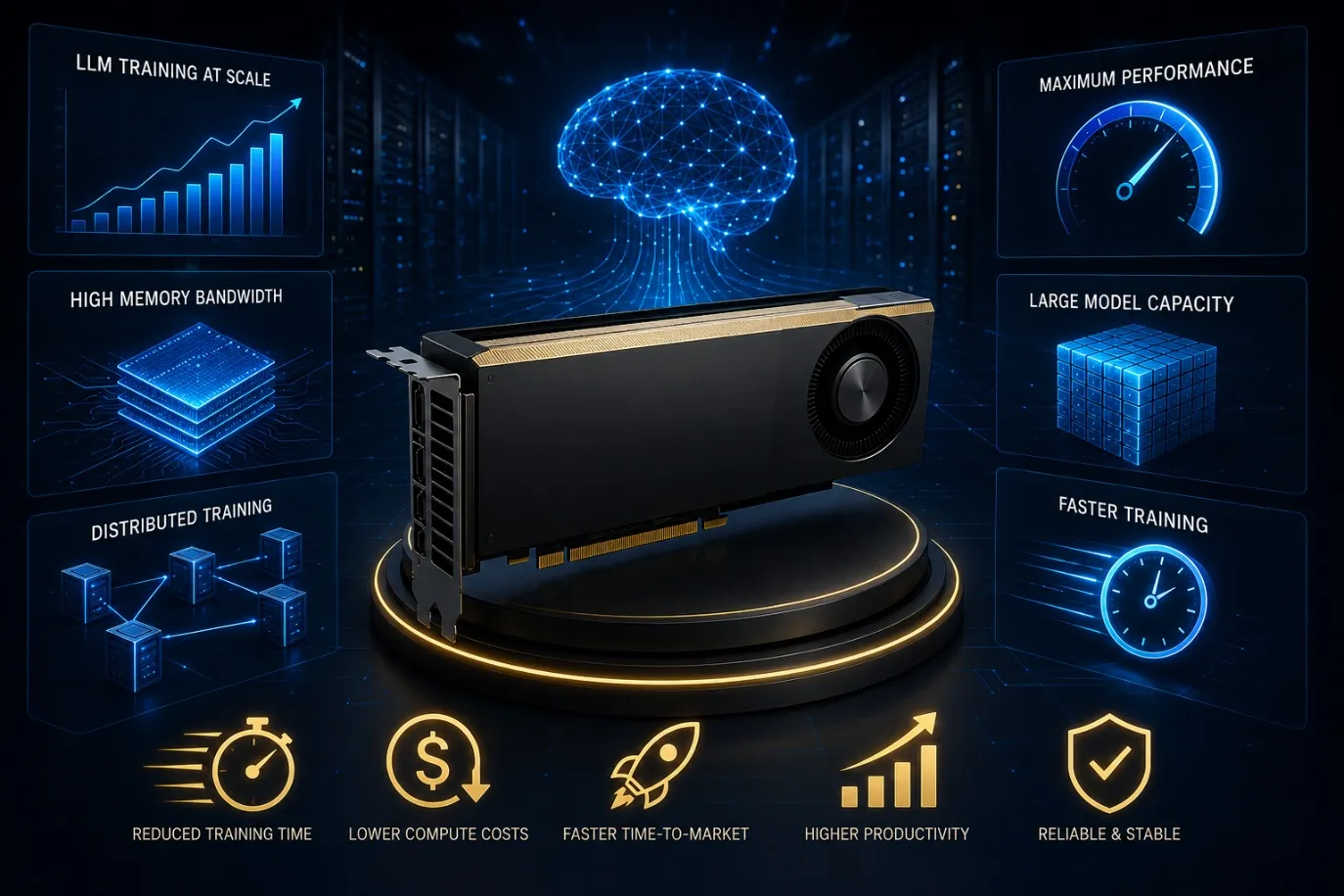
Understanding the Role of the H200 GPU in AI Training
The H200 GPU is ideal for demanding AI applications that have very high memory bandwidth and compute performance needs. It’s designed to significantly speed up the training and inference processes of large language models, generative AI applications, and other compute-intensive ML workloads.
LLM training involves processing trillions of parameters across massive datasets. To do this, one needs a GPU capable of parallel calculations and having bottlenecks in memory accesses and data transfers.
To fulfill these demands, an H200 GPU is designed. So, currently, one of the most strong accelerators to train AI model.
Why LLM Training Demands High-End GPUs
Training large language models is fundamentally different from running traditional machine learning workloads. It requires:
-
Massive parallel processing power
-
High memory bandwidth
-
Large VRAM capacity
-
Efficient multi-GPU scaling
-
Stable long-duration compute performance
Older GPU architectures often struggle with these requirements, leading to longer training times and higher operational costs.
That is why even companies looking to evaluate the H200 GPU price are also looking at training efficiency, speed up for training, not just price alone.
What Makes the H200 GPU Different
The H200 GPU stands out because it is designed to handle extreme-scale AI workloads with improved memory and compute efficiency. It is especially efficient for transformer-based architectures, used prevalently by many modern LLMs.
Key advantages include:
-
High-bandwidth memory for faster data access
-
Improved throughput for matrix-heavy computations
-
Better performance for distributed training setups
-
Reduced training time for large models
With these capabilities, it is well-suited for organizations that are looking to train foundation models or support large-scale AI research operations.
The Real Question: Is the H200 GPU Price Justified?
The greatest worry for many organizations is whether the performance improvement from the H200 GPU will be worth its cost. The H200 GPU price has substantially increased in relation to older generations of GPUs and therefore requires a strong ROI calculation.
For a firm to consider value, it must go beyond cost of hardware. The actual comparison is between:
-
Higher upfront investment vs. faster training cycles
-
Expensive hardware vs. reduced compute time
-
Premium pricing vs. long-term operational savings
In most cases, faster training means lower cost of cloud computing, faster iteration, and faster time-to-market.
When the H200 GPU Is Worth the Investment
The H200 GPU becomes highly valuable in specific scenarios where performance directly impacts business or research outcomes.
1. Training Large Foundation Models
Those that build LLMs from scratch have the most to gain from its High Memory Bandwidth & High compute.
2. AI Research at Scale
Institutes conducting large-scale and difficult experiments need rapid iteration, which the H200 can facilitate.
3. Enterprise-Grade AI Platforms
For enterprises that need to provide private AI models to their users, they must be able to provide their training infrastructure efficiently and stably.
4. High-Volume Distributed Training
H200’s very high scaling efficiency gains from multiple GPUs are compelling.
In these cases, the higher H200 GPU price is often justified by performance gains.
When It May Not Be Cost-Effective
Despite its capabilities, the H200 GPU is not necessary for every workload.
It may not be cost-efficient for:
-
Small or medium-sized model training
-
Basic fine-tuning of existing LLMs
-
Startups with limited AI workloads
-
Inference-only applications
In these use cases, lower-cost GPUs may actually offer better value for money and will provide sufficient performance.
The Hidden Cost Factor: Time
Another important, but not so often mentioned, factor in evaluating H200 GPU price is time. Hardware costs can be less important than the value of time within the field of AI.
Faster training means:
-
More experiments in less time
-
Faster deployment cycles
-
Quicker product iteration
-
Reduced cloud compute duration
However, even if the H200 GPU has a high purchase price, it may contribute to a reduction in project cost by greatly accelerating the training period.
H200 GPU in Cloud vs On-Premise Deployment
Another important consideration is how the GPU is deployed.
Cloud Deployment
-
No upfront hardware cost
-
Pay-as-you-use pricing
-
Easier scalability
-
Higher long-term usage cost
On-Premise Deployment
-
High initial investment
-
Lower long-term cost if fully utilized
-
Requires infrastructure maintenance
These two models may lead to quite a different effective H200 GPU price depending on workload behavior.
Is It Worth It?: The Verdict.
The H200 GPU is not just about raw performance—it is about accelerating the entire AI development lifecycle. For organizations working on large-scale LLM training, its capabilities can significantly reduce training time and improve efficiency.
Yet, it is very sensitive to workload size, frequency of use, and the cost constraints.
It is worth it if:
-
You are training large-scale AI models
-
You need maximum performance and speed
-
You operate at enterprise or research scale
It may not be worth it if:
-
Your workloads are small or moderate
-
You are focused on inference rather than training
-
Budget constraints are a primary concern
Conclusion
When deciding whether to H200 GPU price will depend on the organization’s balance of value versus cost savings. While H200 is one of the fastest GPUs currently available to use to train A.I., it will really only pay off for organizations capable of fully leveraging what it has to offer.
For large-scale LLM training and advanced AI research, the H200 GPU can deliver significant long-term value. However, for a small-scale workload, it is better to select lower-cost options.
In the rapidly evolving AI landscape, choosing the right GPU is not just a financial decision—it is a strategic one.
2 comments
Great post—here’s a quick checklist I use when planning telescope observations: confirm target visibility and field of view, verify focus and tracking stability, review instrument calibration needs, plan an observation cadence that matches the signal strength, choose suitable filters/exposure times, and log conditions (seeing, sky background, guiding) alongside frames. Afterward,
Great project—here’s a quick checklist for CredSwap’s tech direction: verify onboarding flows are friction-light, keep wallet/auth secure-by-default, ensure smart contract logic is well-audited, add clear token/fee transparency, instrument analytics for error triage, optimize for low-latency UX, and document integration steps for developers. Strong startups often balance speed with trust, and
Ycombinator